Autobiography in CO2
While the atmosphere in 2025 averaged 427 parts per million (ppm) carbon dioxide, my breath exhalation is 44,000 ppm.
Put another way, the atmosphere is made up of 0.04% CO2 and my breath is 4.4% CO2. I’m a 100x the gasbag of our planet! Life is the great metabolizer! Bless the Autotrophs for making my respiration even possible.
year ppm CO2
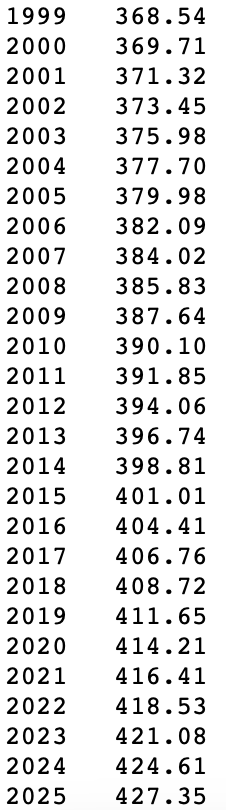
from https://gml.noaa.gov/ccgg/trends/data.html “Mauna Loa CO2 annual mean data”
In 1999 when I took a course in Environmental Toxicology with Murray McBride, the average annual CO2 concentration in the Northern Hemisphere was 368.5 ppm. In 2000 when I was trying to get my University to sign onto the Kyoto protocol, the average CO2 was 369.7 ppm CO2. In 2001 when I was offered a job to analyze greenhouse gas (GHG) emissions on working lands, it was 371.3 ppm CO2. In 2002 when I actually started working on it, it was 373.4ppm CO2. When asked now, I just say it is about 430ppm CO2. I can’t tell you how much I have tracked that number and asserted that number.
Early on in my greenhouse gas career, I taped a table of ‘agricultural GHG emissions’ to my computer screen. It had a very humorous and important assumption in a small footnote. It said something to the effect: this analysis does not include any emissions from the human animals running the farm. This was more than 20 years ago. At that time, while I certainly was aware of how many resources went into making me exist, that I farted methane, and that I respired CO2, I did not know my breath was 44,000ppm CO2. I only just learned that yesterday.
I have been working with my brother Coburn to add a CO2 sensor to my mud projects to see how much CO2 is off-gassing from my living mudpaintings. I want to add them to a piece I will be installing this spring at the RARE (Rensselaer Astrobiology Research and Education) Center. And so I bought two CO2 sensors from Atlas Scientific. My brother built a board and wrote code for a raspberri pi, and over winter break I hooked up at my mom’s house and hung it from a branch on her rosemary bush. The first sensor average about 2,000ppm CO2. A fast google search declares it’s unhealthily over 1000ppm. But I was not dead, my mom was not dead, and I had a clear head. So I briefly huffed into it and it went up to 2500ppm (the sensor collects a lot of times, and the program is set to report an average every 30 min), I put it out in the freezing fresh air and it went down to 1700ppm. Then I exclaimed to all my friends how I had been saying to everyone previously atmospheric CO2 was 430ppm (gas mixing as gas does) and never even considering what it might be close to the ground where all this living was doing*.
* I wasn’t faulty. but a scientist must pay attention to what the data are saying, so I was reporting my new data from my early experiments in earnest. I was getting a larger picture of how that number becomes that average annual atmospheric concentration.
(you can ignore this next bit - it’s a love-ramble with the process of science that I wholeheartedly adore!)
My brother had an identical CO2 sensor in his home in Oregon. it was getting numbers around 430ppm outside.
So I took my first CO2 sensor to my apartment in NYC and it read 3000ppm CO2, hanging it out the window it got down to 1500ppm. When I went out for dinner (with the windows closed) it went down to 2000ppm, when I was zoom chatting a foot away, it went back up to 3500ppm.
So then in an effort to see what NYC CO2 levels were reporting elsewhere, I found Ricardo Toledo-Crow, who runs this amazing sensor library (Next Generation Environmental Sensor Lab) through the CUNY Advanced Science Research Center. He confirmed 430ppm.
Then I traveled back to NH and hooked up the 2nd CO2 sensor, and it got 1500ppm inside and ~430ppm outside.
Then I googled Atlas Scientific (they were in Queens!!!), so of course I called them and chatted with Efrem (he picked up the phone and was not a bot! Blessed be!).
I asked, what readings he got with his own sensors in the lab. He confirmed 430ppm outside.
So then I asked, how do I calibrate the sensor. He said, bring it on down! They had CO2 tanks to calibrate it. It would take <15 minutes!
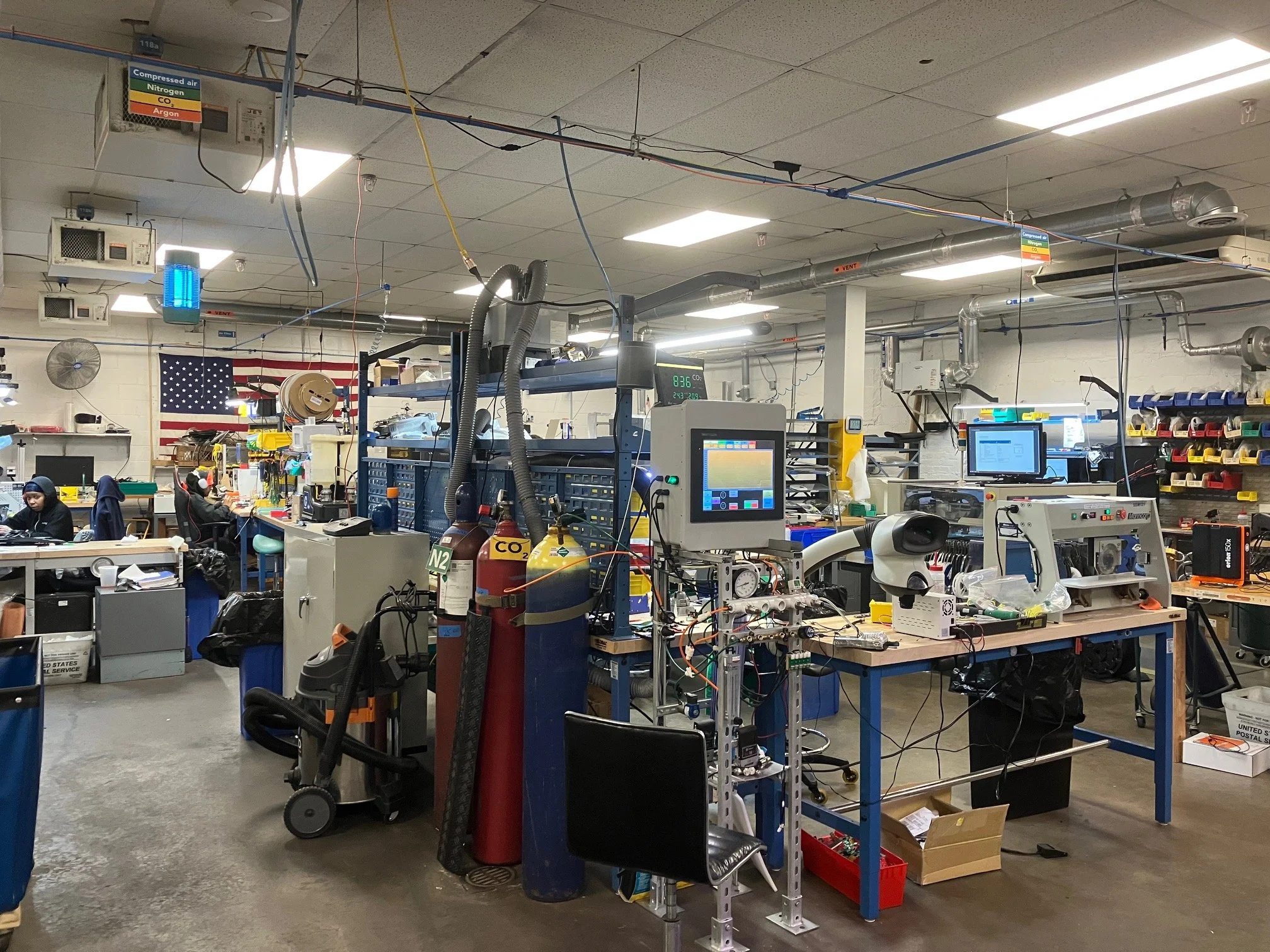
Atlas Scientific in Long Island City, NYC
Yesterday evening, Efram’s colleague, Max, calibrated both my CO2 sensors!
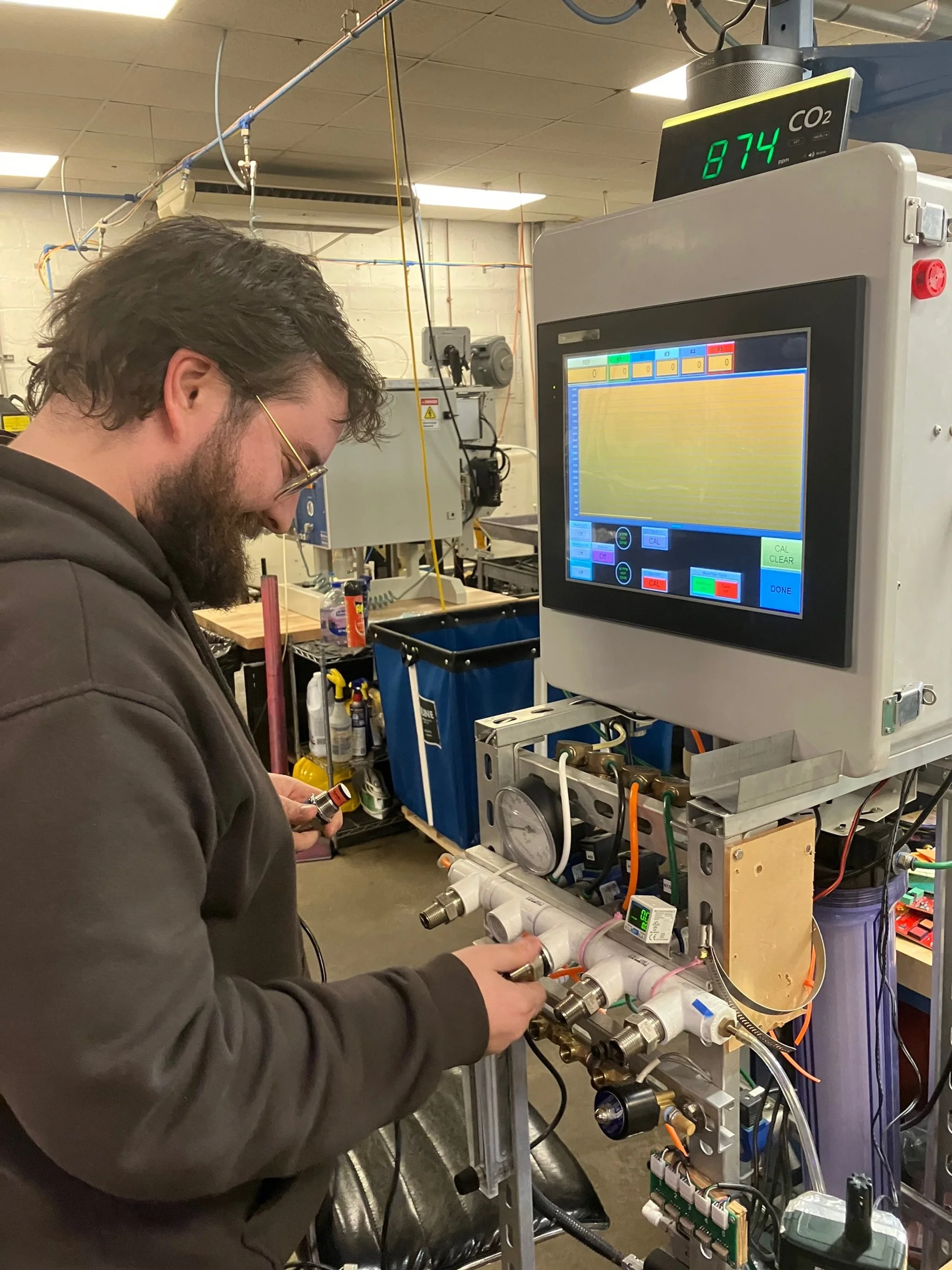
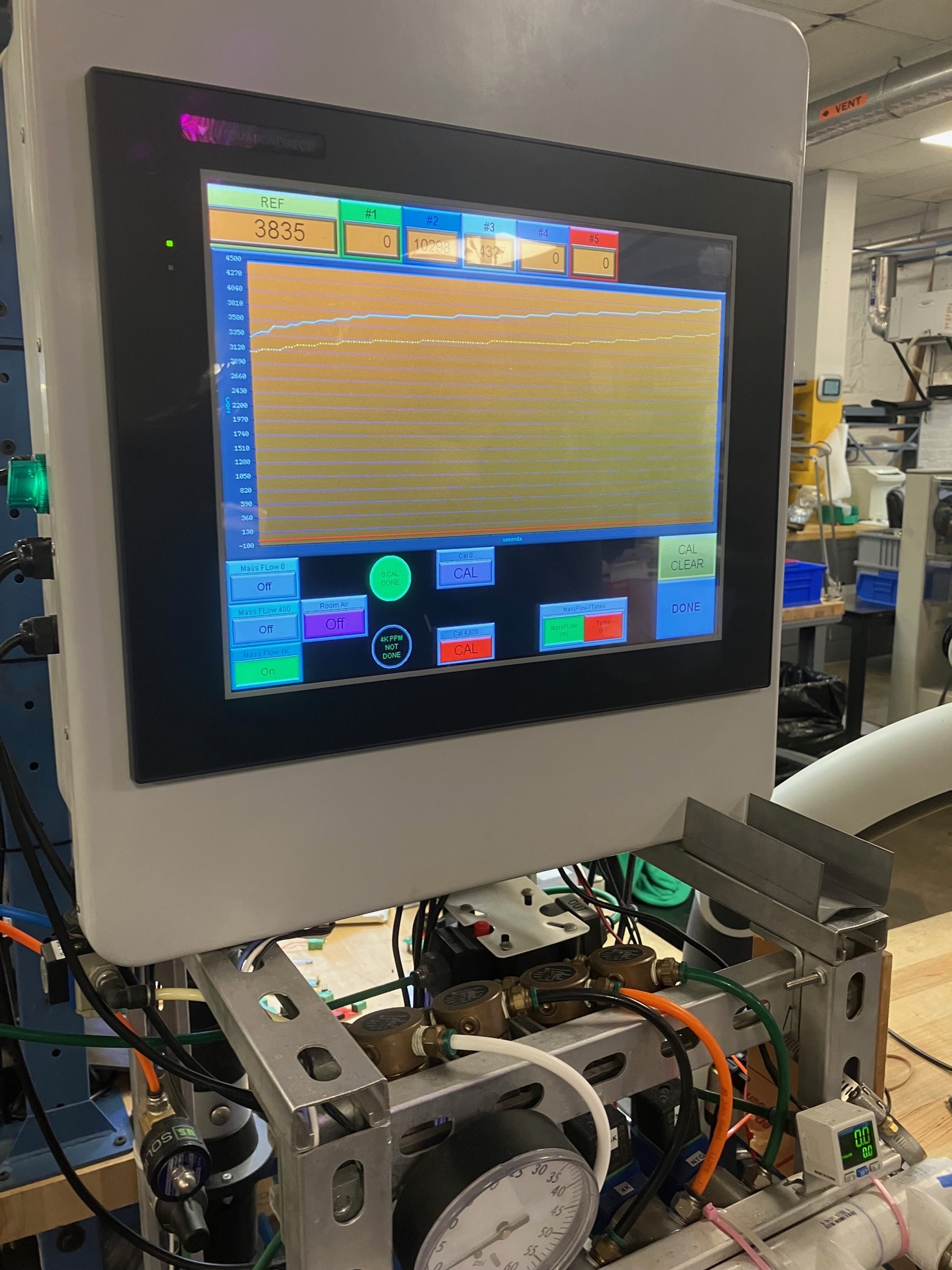
Look, my 1st Co2 sensor (reading high) is being screwed in the #2 port of the calibrator!
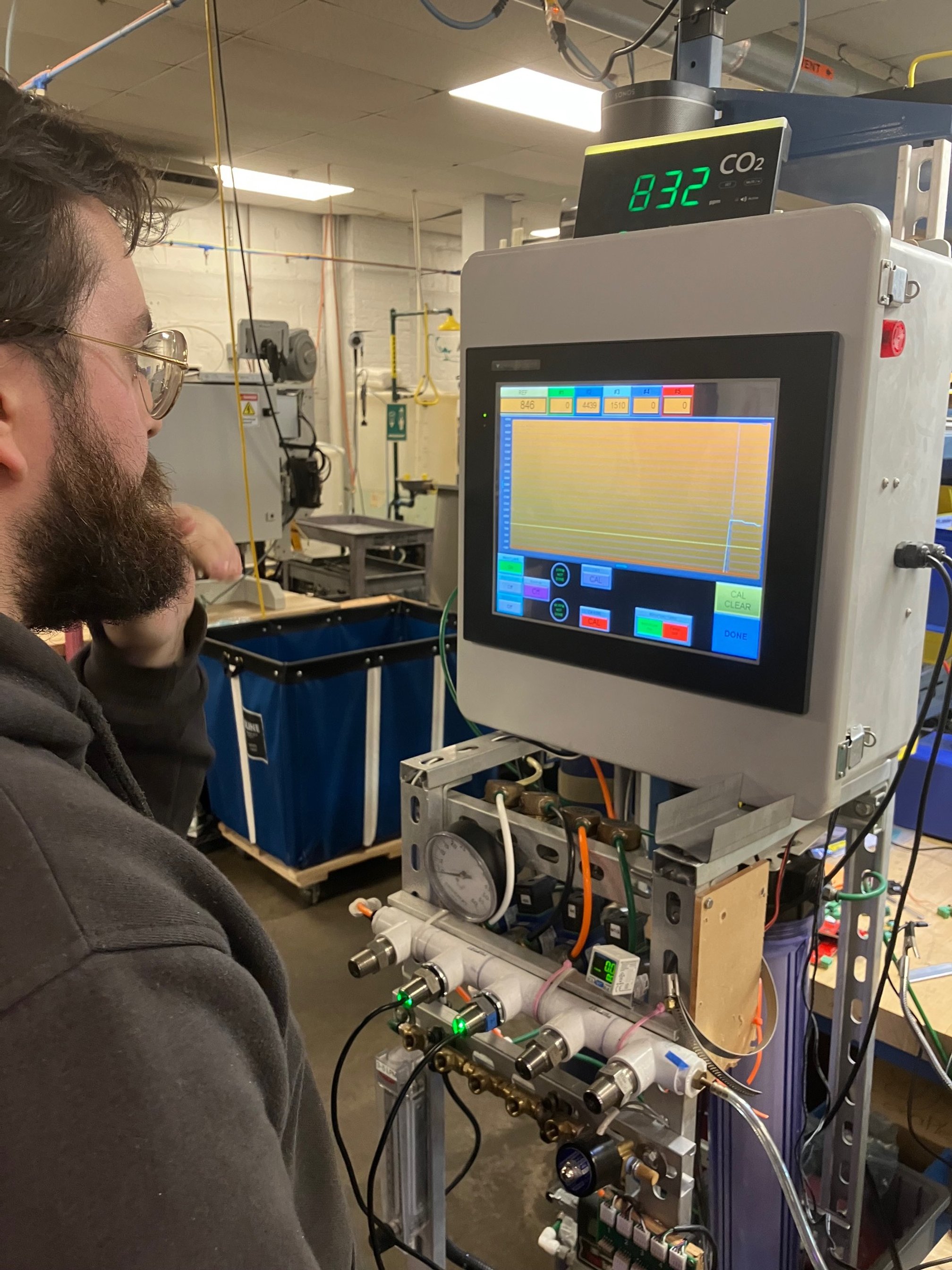
Note port 2 is 2x higher than port 3 (the 2nd sensor that was reporting more accurately)!
First they received pure N2 gas to get single digit readings (the 0 value)
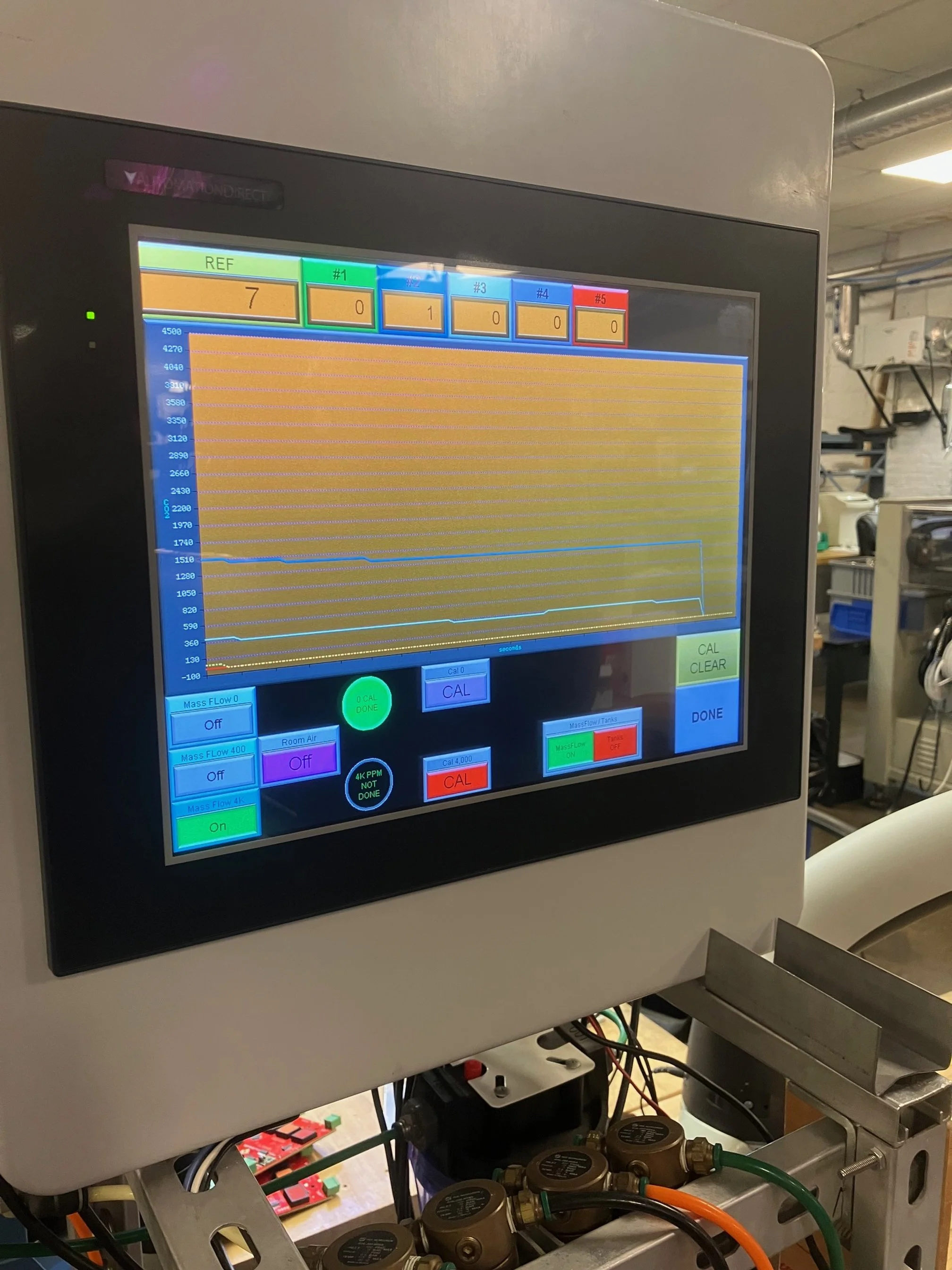
Then they blew in CO2 gas at 4000ppm
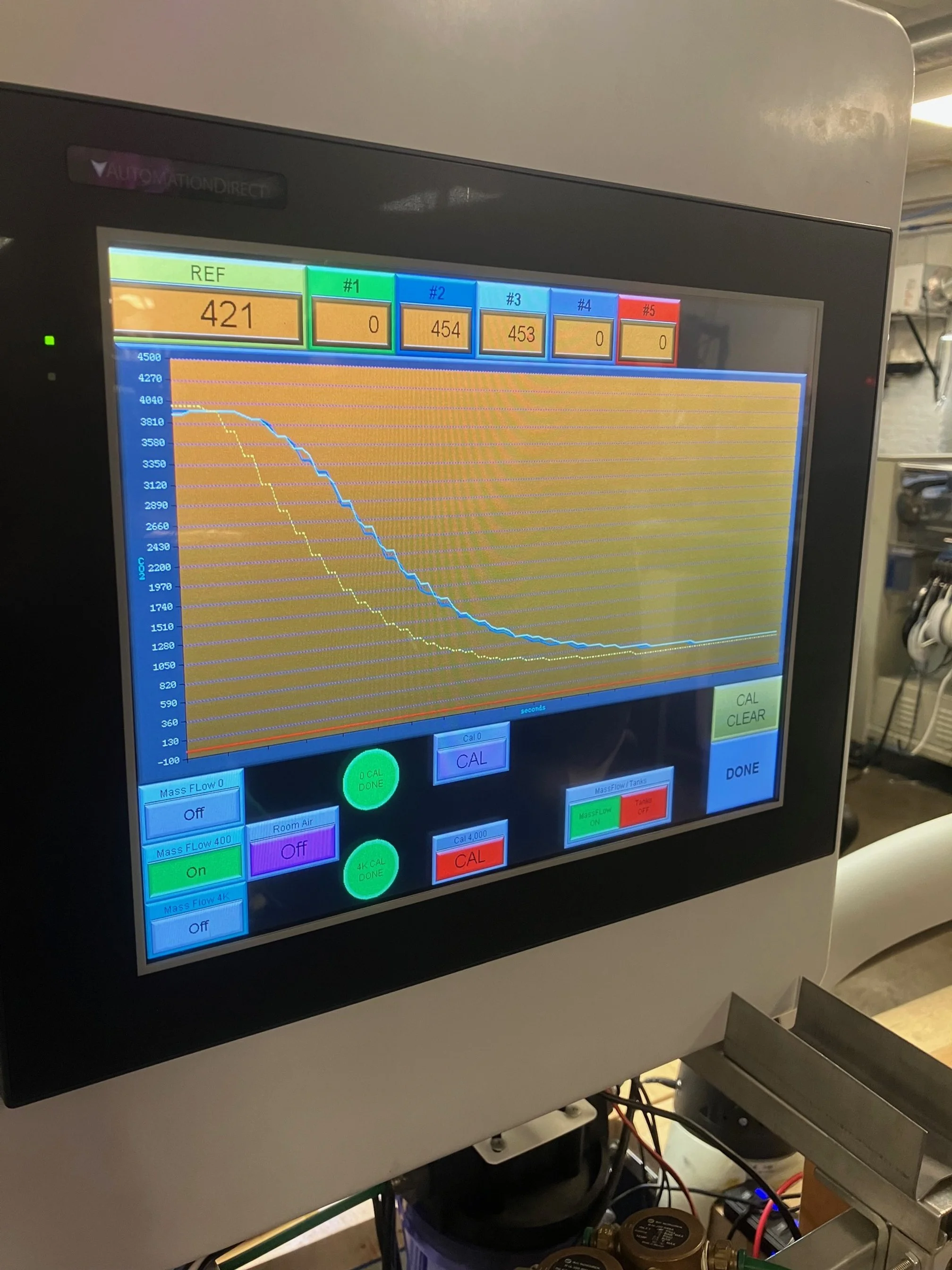
Then they diluted the CO2 gas to get a 400ppm!
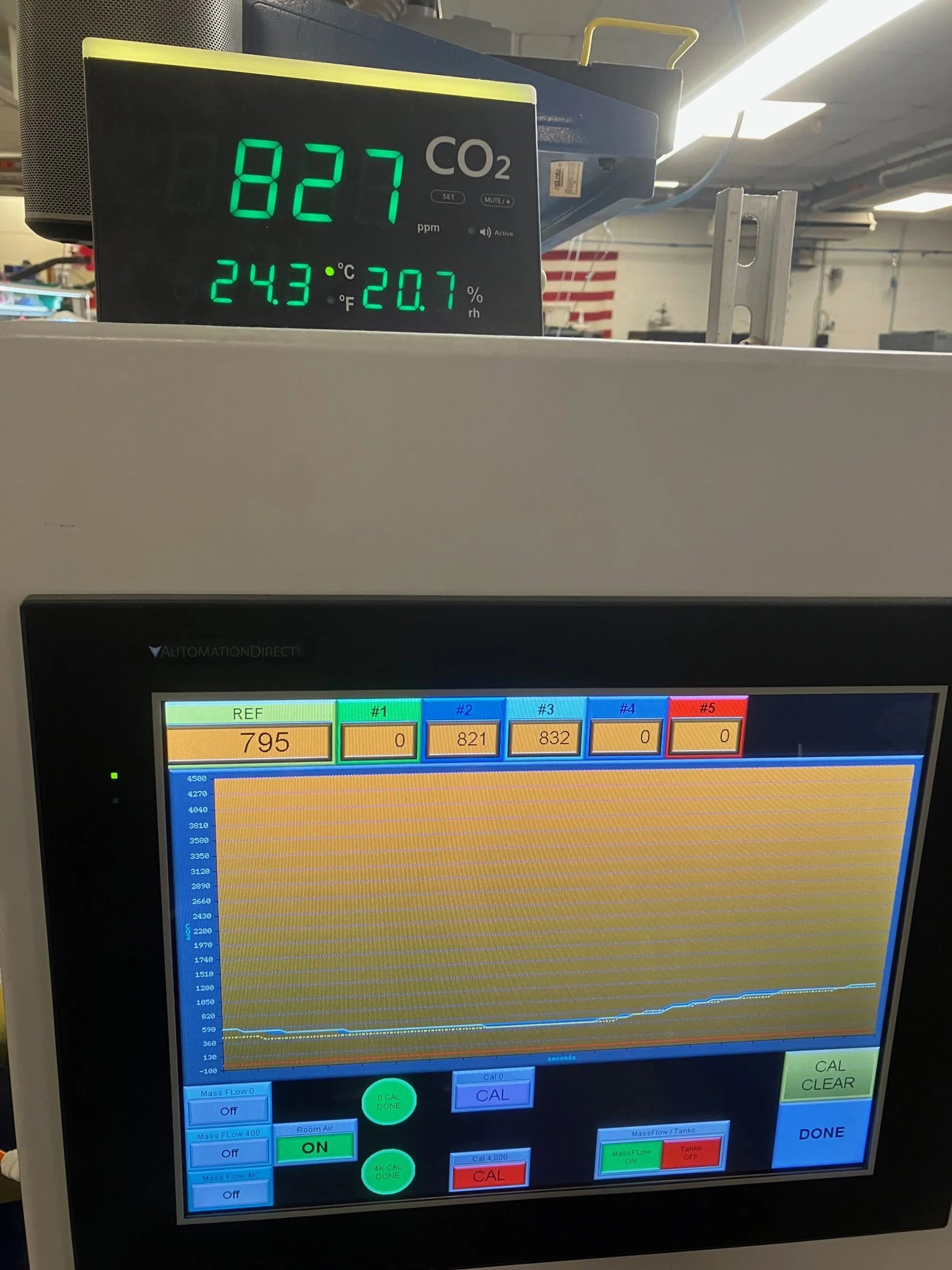
Then they read the room! at that time the room was reporting 827 ppm!
It was SO satisfying! Humans can be so neat when we are not being awful.
Now, I have 2 co-calibrated CO2 sensors for my spring installation at RARE. The plan is to put one, nose down into the airspace above the mud/water, the other will hang outside of the mud frame. With a +/- 50ppm sensor resolution (so 100ppm spread potential between both sensors) and kids walking thru the hallways exclaiming whatever they exclaim (at 44,000ppm, or huffing into the free hanging sensor as an experiment or as a prank), I’m not sure I’ll be able to meaningfully detect and/or interpret the CO2 respiration from my mud or the common space where the mud will be living. But that is science! you learn what you can learn, when you can learn it! And that is really something!