Tisiphone?
I am done with Cassandra. The one fated to utter truths but never to be believed.
I’m headed into the Furies! Maybe Tisiphone.
I am done w the ‘climate crisis’! We know what needs to be done! So let’s lean in and do It!
BRING BACK ACCOUNTABILITY AMERICA!
(I am also done with offshore killings,
killing in general,
the loss of due process at Guantanamo,
the monied legacy of “citizens united”
the dismantling of truth,
masked men,
un-masked extortionists…
the list is very long!)
I am working on a paper about the miracle of autotrophy (microbes, plants). And how once Earth invented chemosynthesis to make all the miraculous organic matter out of the previously abiotic world, we necessarily needed decomposition (otherwise all life would be tied up in first generation biomass) for the cycle of life to keep rolling. Enter all the amazing heterotrophs our planet evolved to do this service of chomping up all the industry of the autotrophs! We (you and me) are heterotrophs!
Unlike autotrophs that fix carbon into chains of stored energy within their own body, humans are heterotrophs. For sustaining our corporeal life, we consume the bodies of other creatures and either re-use those organic chains to make our own bodies and/or break down those chains for energy through our daily respiration. We have also become historic heterotrophs, metabolizing ancient biomass storing ancient sunlight energy—fossil fuel—to run contemporary society. In his 1996 book Beyond Growth economist Herman Daly relates our economic systems to the land. “Peasant societies lived off the abundant solar flow; industrial societies have come to depend on enormous supplements from the limited terrestrial stocks.”[1] We are using a trust fund of mineral and energy terrestrial stocks at alarming rates, returning buried C as CO2 to the atmosphere, creating wastes, and reducing non-renewable energy resources for future generations. Just as Sergei Winogradsky in the 1880’s realized that decomposition was as important as synthesis, we need to understand that human biological+technological dissolution of complex carbon resources needs balance or else our rapid return of CO2 to the atmosphere will change how our biosphere works.
[1] Herman Daly, Beyond Growth – The economics of sustainable growth, (Boston: Beacon Press, 1996), 30.
Of note, Herman Daly recently passed away. He was the number 2 person I had wished to gRift.
As currently configured, the Earth, is, for all intents and purposes, a perpetual motion machine. Gravitationally orbiting the massive light energy of our second+ generation star, the Earth is home to one of more expansive lists of elements in the periodic table, providing a rich ground of diverse minerals for life to engage. In that sense, there are no ‘limits’ to the expressiveness of our biosphere as long as our sun keeps burning. Microbes have always driven the global nutrient cycles until humans discovered fossil fuels impacting global carbon cycles. The rate of human combustion of fossil fuel is rapidly changing the atmospheric concentration of CO2 affecting the global balance. In the following chart, the blue line before the industrial revolution (~1750) represents an atmospheric equilibrium of about 280 parts per million (ppm) of CO2 resulting from the net flux of all biologic processes. The gray line represents the increase in CO2 resulting from large scale mining and combustion of buried carbon (the geologically compressed biomass synthesized by ancient life of Carboniferous and Mesozoic eras) for energy. Combusting fossil fuels both releases the energy stored in the C-C bonds to do work for humanity while it also oxidizes the C-chains back to CO2, a gas that travels to the atmosphere, resulting in a net increase in atmospheric CO2. Combined, our contemporary atmosphere now holds more than 420ppm CO2 (blue line 2020).
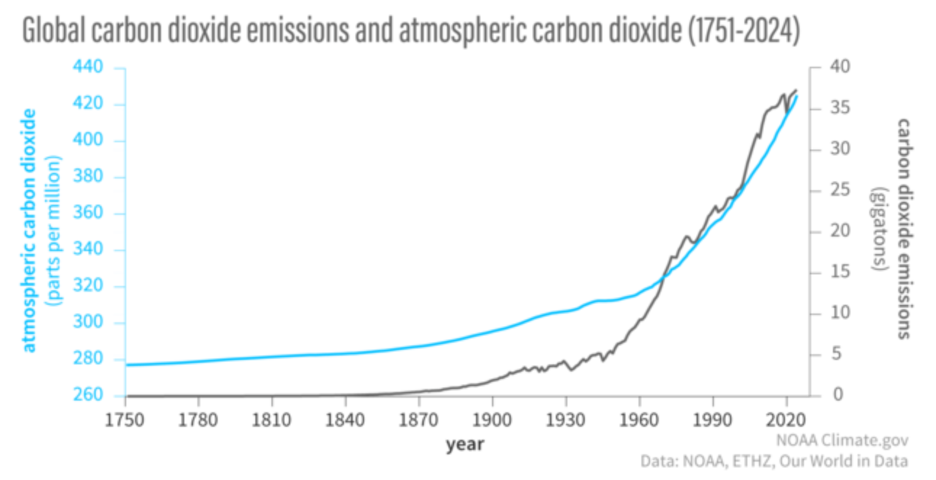
“The amount of carbon dioxide in the atmosphere (blue line) has increased along with human emissions (gray line) since the start of the Industrial Revolution in 1750. Emissions rose slowly to about 5 gigatons (1 gigaton is 1 billion metric tons per year) in the mid-20th century before rapidly increasing to more than 35 billion tons per year by the end of the century. NOAA Climate.gov graph, adapted from original by Dr. Howard Diamond (NOAA ARL). Atmospheric carbon dioxide data from NOAA and ETHZ. Carbon dioxide emissions data from Our World in Data and the Global Carbon Project.”
Rebecca Lindsey, “Climate change: atmospheric carbon dioxide” published 21 May 2025, accessed 12 October 2025, https://www.climate.gov/news-features/understanding-climate/climate-change-atmospheric-carbon-dioxide#:~:text=Highlights,was%20before%20the%20Industrial%20Revolution
If early life evolved decomposition to complement tying up all the bio-synthesis going on, humans need to think how we can complement all our decomposition (metabolic and technologic) of organic matter living and ancient. Yes, it’s a dynamic equilibrium. But right now, it’s a one-way dead end street, dumping all those carbon resources into our atmosphere.